
865+ Five-Star Reviews - (623) 226-4454




FAQ Section
Trustworthy
Quality Focused
Financing Available
Locally Owned
Phoenix's #1 Trusted
Pool professionals
WHERE EXCELLENCE IN POOLS MEETS UNPARALLELED SERVICE
Trustworthy
Locally Owned
Quality Focused
Financing Available
COMMON QUESTIONS
How long has Triton Been Around?
We've been around for over 10 years. We have been in the service industry in the Phoenix Valley for over 25 years and counting. We strive to provide the best quality service to all customers in the Phoenix Metro area and our reviews show just that. Reputation is our #1 priority and we want to make sure we provide the best service with the best warranty.

What makes Triton different?
Triton makes things different by trying to put the customer first, meaning we've done things with you in mind. For example one of those things being equipment pricing, we've outsourced our own Pumps, & Salt Cells to ensure we give you the best possible product with the best warranty in the industry.
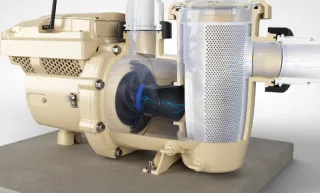
How often should I have my pool equipment looked at?
Getting your pool equipment look at regularly is the equivalent of getting an oil change. We recommend getting your pool equipment tuned up and inspected once a year usually before summer or during the winter months.
Why is my pool pump making strange noises?
Strange noises from your pool pump can indicate various issues, such as worn-out bearings, debris stuck in the impeller, or air leaks in the suction line. It's essential to address these issues promptly to prevent further damage and maintain optimal pump performance.
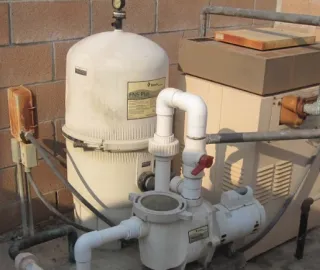
How often should I run my pool pump?
The recommended runtime for a pool pump depends on factors such as pool size, bather load, and climate. As a general rule, running the pump for 8-12 hours per day during the swimming season helps maintain proper circulation and filtration.
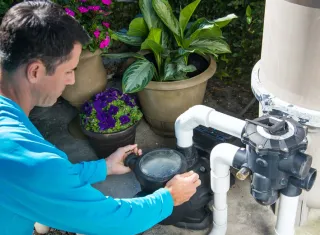
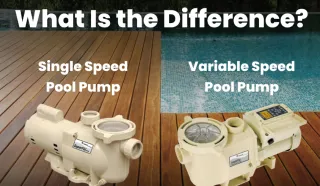
What is the difference between a single-speed and a variable-speed pool pump?
Single-speed pumps operate at a fixed speed, while variable-speed pumps allow you to adjust the speed to match your pool's needs. Variable-speed pumps offer greater energy efficiency and quieter operation, making them a popular choice for pool owners looking to reduce energy costs.
How can I troubleshoot common pool pump problems?
Common pool pump problems such as low flow, leaks, or priming issues can often be resolved through simple troubleshooting steps like checking for clogs, inspecting seals and gaskets, and ensuring proper water level. If troubleshooting doesn't resolve the issue, it's best to consult with a professional pool technician for further assistance.

INFORMATIONAL ARTICLES
How a Pool Heater Works to Heat Your Pool Water
There's nothing quite like slipping into a perfectly heated pool, especially when Phoenix mornings are cooler than expected or the evenings start to dip. But how does that water go from cold to comfortable? The answer lies inside your pool heater, and once you understand how it works, the whole system starts to make a lot more sense.
Whether you're troubleshooting a problem, shopping for a new unit, or just curious, here's a straightforward breakdown of the technology behind pool heating.
The Basic Job of a Pool Heater
At its core, a pool heater has one job: raise the water temperature to wherever you want it and keep it there. It does this by pulling water from your pool through the plumbing system, heating it using a fuel or energy source, and then sending it back into the pool.
The thermostat controls the entire cycle. Once the water reaches your target temperature, the heater shuts off. When it drops below that point, the heater kicks back on. Simple in theory, but the way different heaters accomplish this varies quite a bit.
How Gas Pool Heaters Work
Gas heaters are one of the most common options in residential pools, and they're particularly useful when you need fast results. They run on either natural gas or propane, both of which are combustible fuels that release a significant amount of heat when burned.
The Combustion Process
When you set your thermostat and the heater activates, gas flows through a valve into the combustion chamber. There, it ignites and burns. The heat from that combustion passes through a heat exchanger, which is essentially a series of copper or polymer tubes through which water flows on its way back to the pool.
The water absorbs the heat from those tubes and exits significantly warmer than when it entered. A brand like Pentair designs these components to optimize heat transfer while maintaining durability under pressure.
Measuring Output in BTUs
Gas heater performance is measured in British thermal units, or BTUs. One BTU is the amount of energy needed to raise one pound of water by one degree Fahrenheit. A heater rated at 400,000 BTUs can heat water faster than one rated at 200,000 BTUs, though fuel consumption increases accordingly.
The orifice plate inside a gas heater controls how much gas enters the combustion chamber.
This small component plays a big role in regulating heat output and fuel efficiency.
How Heat Pump Pool Heaters Work
Heat pump pool heaters are a completely different technology. Instead of burning fuel to create heat, they move existing heat from the surrounding air into the water. This distinction is what makes them one of the most efficient energy-use options available for pool owners.
From Air to Water
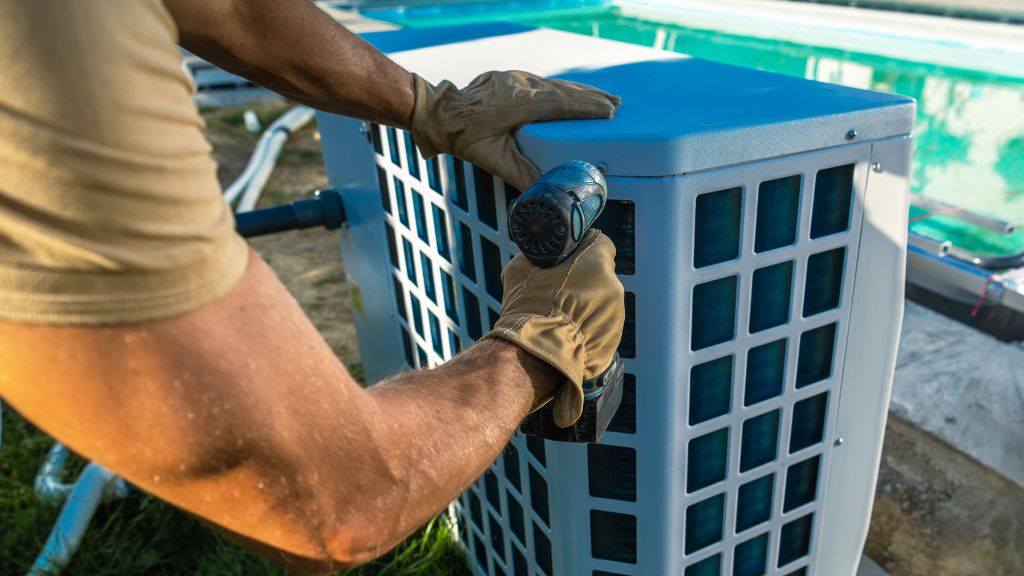
Here's how the process works. A fan pulls in ambient air and passes it over an evaporator coil.
That coil contains refrigerant, which absorbs the heat from the air and turns into a gas. The compressor then pressurizes that refrigerant gas, which raises its temperature significantly.
That hot refrigerant passes through a heat exchanger, where it transfers its heat to the pool water flowing through the pipe. The refrigerant then cools back down, returns to liquid form, and the cycle repeats.
This process closely resembles how HVAC systems work in homes, just applied to water heating instead of indoor air.
Why Efficiency Matters Here
Because heat pump pool heaters are moving heat rather than generating it from combustion, they use far less electricity to deliver the same temperature increase. They're a form of electric heating that consistently delivers more energy output than the energy they consume.
The trade-off is speed. Heat pumps are more dependent on weather and ambient air temperature. In cooler climates, their efficiency drops. In Phoenix, however, the warm climate makes heat pump pool heaters a strong investment for most of the year.
Solar Thermal Collectors: A Third Option
Some pool owners go even further by adding solar thermal collectors to their setup. These panels are typically mounted on a roof and use the sun's energy to heat water as it flows through the collector before returning to the pool.
Solar heating has essentially zero operating cost once installed, though it depends heavily on sun exposure and is best paired with a backup heater for cloudy days or rapid temperature adjustments. In Phoenix's sunny climate, this option can significantly reduce long-term energy costs.
What Happens Inside the Plumbing System
Regardless of which heater type you use, the pool's pump and plumbing system are what make everything flow. The pump and filter draw water through the filter first, then push it through the heater, and finally return it to the pool through return jets.
Proper water pressure is essential. If pressure is too low, the heater may not fire at all. If it's too high, it can stress the heat exchanger and reduce the lifespan of the unit. Keeping your pump and filter in good shape directly affects how well your heater performs.
Signs Your Pool Heater Needs Attention
Even well-built heaters eventually need service. Here are a few signs that something may be off:
The water isn't reaching your set temperature
The heater is cycling on and off too frequently
You notice unusual sounds coming from the unit
There are visible signs of corrosion or damage near the heat exchanger
The unit is well past its warranty period and is showing reduced efficiency
If any of these sound familiar, it's worth getting a professional inspection before the problem worsens or affects other parts of your pool system.
How to Keep Your Pool Heater Working Efficiently
Understanding how your pool heater works helps you make smarter decisions, whether you're choosing a new unit or figuring out why your water isn't warm enough. Gas heaters offer fast heat through combustion, heat pump pool heaters use refrigerant and a compressor to move heat from the air, and solar thermal collectors tap into free energy from the sun. If your heater isn't performing the way it should, our pool heater services are here to help. Call us at 623-226-4454 to schedule a visit.

wHERE WE SERVICE
SERVING PHOENIX METRO ARIZONA
Apache Junction
San Tan Valley

Connect With Us


