1,000+ Five-Star Reviews - (623) 226-4454




Pool Maintenance Services in Phoenix, AZ
Trustworthy
Quality Focused
Financing Available
Locally Owned
How to Lower Cyanuric Acid in Pool Water
If your pool's chlorine seems to disappear faster than it should, or your water is stubbornly cloudy despite regular chemical treatments, cyanuric acid might be the culprit. It's one of those pool chemistry issues that sneaks up on you slowly, and by the time you notice it, the problem is already well-established.
The good news is that lowering cyanuric acid in pool water is absolutely manageable. You just need to understand what it is, why it builds up, and what your realistic options are for bringing it back under control.
What Is Cyanuric Acid and Why Does It Matter?
Cyanuric acid - often referred to simply as CYA - is a chemical stabilizer used in swimming pools to protect chlorine from being broken down by ultraviolet rays from the sun. Without it, chlorine in outdoor pools can degrade rapidly, sometimes within hours of being added to the water.
It's commonly found in stabilized chlorine products like dichlor and trichlor tablets. Every time you add these products to your pool, you're adding both chlorine and cyanuric acid. Over time, the CYA accumulates because while chlorine gets consumed, cyanuric acid largely stays put in the water.
The Right Level vs. The Problem Zone
The ideal range for cyanuric acid in a swimming pool is generally between 30 and 50 parts per million (ppm). Some pool professionals push this range slightly higher for outdoor pools under intense sun exposure, but most agree that anything above 100 ppm is a serious concern.
When CYA climbs too high, it locks chlorine into a less effective form, reducing its ability to sanitize the water. This is sometimes called "chlorine lock," and it means algae, bacteria, and other contaminants can thrive even when your chlorine readings look fine on paper.
High CYA vs. Other Chemistry Problems
It's worth noting that cyanuric acid is not the same substance as the acid you'd use to adjust pH or alkalinity. Those adjustments typically involve muriatic acid or sodium bisulfate. CYA is a distinct substance in chemistry terms, and it cannot be lowered by adding more chemicals - there is no neutralizing agent that simply eats it up in pool water.
This is a critical point that confuses a lot of pool owners. You cannot treat your way out of high CYA the same way you might balance your pH or total alkalinity levels.
Why Cyanuric Acid Builds Up in Phoenix Pools
In Phoenix, Arizona, outdoor pool use is year-round, and that means stabilized chlorine products get added to the water continuously. Unlike cooler climates where pools are winterized and often partially drained, Phoenix pool owners are running their systems in full operation almost every month of the year.
Add to that the intense desert sun - which drives up chlorine consumption and encourages heavier use of stabilized products - and you have a recipe for CYA accumulation. Evaporation also plays a role. As water evaporates from the pool, CYA remains behind and becomes more concentrated in the remaining water.
How to Lower Cyanuric Acid in Pool Water
Here's the straightforward reality: there is no reliable chemical method to lower cyanuric acid in pool water. The most effective solutions all involve physically removing water from the pool and replacing it with fresh water. That's where the phrase "drain, dilute, repeat" comes from.
Option 1: Partial Drain and Refill
This is the most common and cost-effective approach for most homeowners. The process is simple in concept.
You drain a portion of your pool water - typically between one-third and one-half of the total volume - and then refill it with fresh water. Because fresh water contains zero CYA, diluting the remaining pool water brings the overall concentration down proportionally.
For example, if your pool measures 80 ppm and you drain half the water, you're looking at roughly 40 ppm after refilling - right in the ideal range. A submersible pump can speed up the draining process significantly, and most pool service companies have the equipment to handle this efficiently.
One important note for Phoenix homeowners: always check local water restrictions before draining a significant volume of pool water. Wasting water is both a practical and civic concern in the desert.
Option 2: Full Drain and Refill
If your CYA levels are extremely elevated - above 150 or 200 ppm - a partial drain may not be enough to bring things under control in a single session. In some cases, a complete drain is the more practical path forward.
A full drain also gives you the opportunity to inspect the pool shell, address any calcium deposits on the walls, consider an acid wash, or look at remodeling options. It's not a decision to take lightly, however, since draining a pool entirely can put pressure on the structure and create risks like the pool floating if groundwater pressure is significant. Always have a professional assess the situation before doing a complete drain.
Option 3: Reverse Osmosis Water Treatment
Reverse osmosis - often abbreviated as RO - is a water purification method that filters pool water through a semi-permeable membrane, removing dissolved substances including cyanuric acid, calcium, total dissolved solids, phosphate, and even salt without requiring you to drain the pool.
A specialized RO system is brought on-site, and the water is filtered and returned to the pool in a continuous cycle. The result is dramatically reduced CYA levels along with improved overall water chemistry - often in a single day.
This option is more expensive than a simple drain and refill, but it has major advantages. You conserve most of your pool water, which matters in a water-conscious environment like Phoenix. You also avoid the risk associated with fully emptying the pool. In some cases, an RO treatment can bring your water quality close to that of fresh water without the disruption of a full drain.
What About Chemical Additives?
You may have seen products marketed as CYA reducers or cyanuric acid removal agents. Some of these involve biological processes or flocculation-style approaches that attempt to bind and filter out the substance. In practice, results are inconsistent, and most pool professionals - including the team at Triton Pools - remain cautious about recommending them as a primary solution.
Methods like flocculation work well for clearing cloudy water or removing suspended particles, but cyanuric acid is a dissolved substance, not a particle. It doesn't respond to the same treatment chemistry that you'd use for aluminum-based flocculants or alum-based clarifiers.
After You've Lowered CYA: Keeping It in Range
Once you've brought your cyanuric acid down to an acceptable level, maintaining it there is mostly a matter of being thoughtful about which chlorine products you use.
Stabilized chlorine products - including trichlor tablets and dichlor granules - both contain CYA. If your pool is already at the right stabilizer level, continuing to use these products will push CYA higher over time. Switching to unstabilized options like liquid chlorine (sodium hypochlorite) or calcium hypochlorite can help you add sanitizing power without contributing to CYA buildup.
Some pool owners use bleach - which is essentially a diluted sodium hypochlorite solution - as a cost-effective unstabilized chlorine option. It's not ideal for every pool type or situation, but it's a legitimate tool in the chemistry toolkit.
For saltwater pools, cyanuric acid still plays a role since most salt cells generate free chlorine that benefits from some level of stabilization. However, the same rules apply: monitor regularly and avoid letting CYA creep up unchecked.
Testing Frequency Matters
The only way to catch rising CYA before it becomes a big problem is to test your water regularly. Most pool owners should be testing at least once a week during heavy use periods. In Phoenix, where pools are used year-round, that testing frequency should be consistent throughout the year.
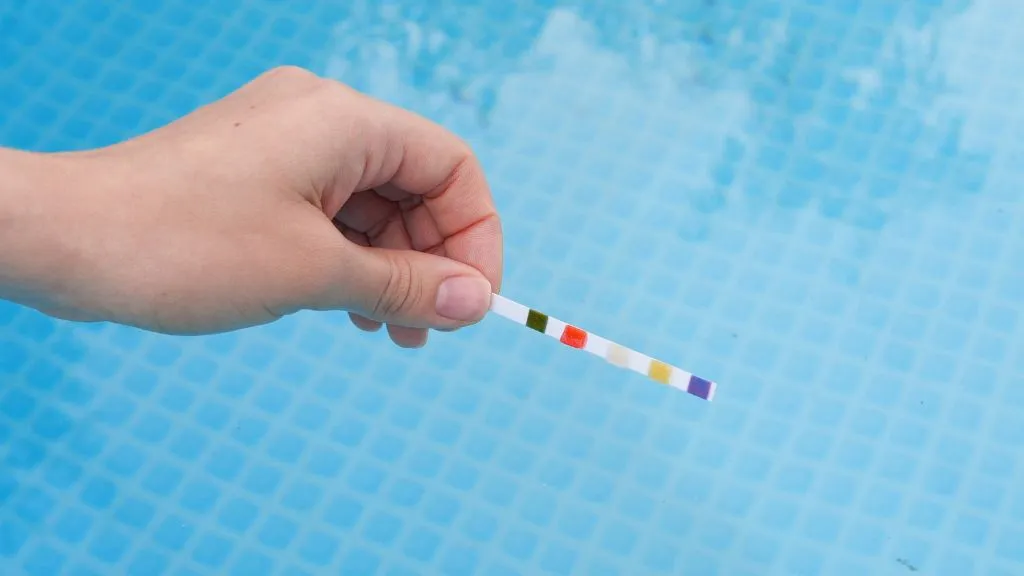
CYA test kits are widely available at pool supply stores. You can also bring a water sample to a pool service company for a more comprehensive chemistry analysis that covers pH, alkalinity, calcium hardness, total dissolved solids, and more.
Is High CYA Dangerous?
Cyanuric acid itself is a low-toxicity substance in the concentrations found in swimming pools. However, the consequences of having too much of it are very real. Ineffective sanitization leads to algae growth, bacterial contamination, and water that is simply not safe to swim in.
Hot tub and spa owners should be especially cautious since the smaller water volume means CYA can rise to problematic levels much faster than in a full-sized pool.
Frequently Asked Questions
How fast does cyanuric acid build up in a pool?
It depends entirely on which chlorine products you use. Pools that rely heavily on trichlor tablets can see CYA levels rise by 30 ppm or more over a single season.
Can I swim while CYA is high?
If CYA is above 100 ppm, your chlorine is likely less effective even if readings look normal. Swimming is not necessarily dangerous from a CYA standpoint, but the reduced sanitization creates other risks.
Does Backwashing lower cyanuric acid?
Backwashing removes a small amount of pool water through the filter, but not enough to make a meaningful difference in CYA concentration. Filtration in general does not remove dissolved CYA.
How much does a partial drain cost?
Costs vary depending on pool size and local service rates, but a partial drain and refill handled by a professional pool service is generally affordable compared to more complex treatments like reverse osmosis.
Take Control of High Cyanuric Acid
High cyanuric acid is one of the most common and frustrating pool chemistry problems, but it's very much solvable. Whether you go the partial drain route or invest in reverse osmosis treatment, the key is acting before levels get out of hand. If you're unsure where to start, the team at Triton Pools is ready to help. Reach out at 623-226-4454 to schedule a pool cleaning service or water chemistry evaluation and get your pool back where it belongs.

Phoenix's #1 Trusted
Pool professionals
WHERE EXCELLENCE IN POOLS MEETS UNPARALLELED SERVICE
Trustworthy
Locally Owned
Quality Focused
Financing Available
Connect With Us


